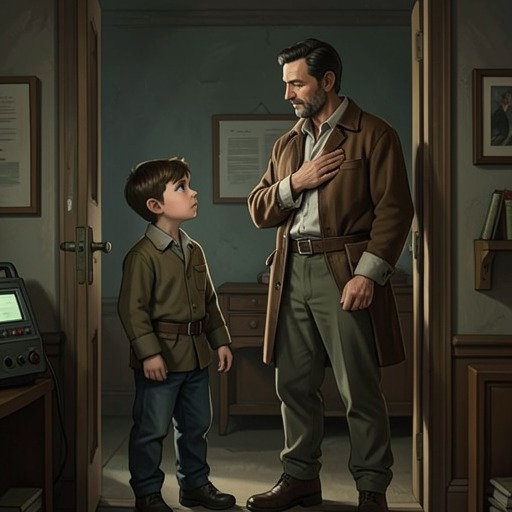
The alien leaves Gulliver unharmed beside the railway tracks
The HumansThe alien narrator’s encounter with Gulliver beside the railway tracks becomes a moment of suspended intervention: the narrator sees the danger, considers whether Gulliver might step into the train’s path, and ultimately withdraws without stopping him. The scene leaves Gulliver physically unharmed, but its uncertainty is central. The narrator cannot know whether Gulliver was trying to die, and the train’s passage offers no answer beyond the fact that he is still there afterward.
Background and Pursuit
The encounter follows the narrator’s discovery that Gulliver knows the world’s greatest mathematical puzzle has been solved by his own father. The narrator has already delayed acting on that knowledge. He told himself he needed more information, including confirmation that Andrew Martin had told no one else, and he was exhausted after his encounter with Daniel Russell. Waiting another day or two had been the plan. Gulliver had promised that he had told no one and would not do so, but the narrator doubts whether he can be fully trusted.
That uncertainty sharpens when the narrator sees Gulliver walking alone along a pavement, trying to hide behind his hair. He should be at school; his mother believes he is there, but he is not. When the narrator calls his name, Gulliver freezes, then turns away and walks faster. The narrator reads this behavior as a cause for concern, with the secret of the proof still inside Gulliver’s head. He follows rather than confronting him, and the pursuit brings him from the park-side houses toward the railway.
At the Railway Line
Gulliver crosses a grass field and reaches four metal tracks running parallel into the distance. He stands completely still, waiting. The narrator and Newton are nearby: Newton looks from Gulliver to the narrator with concern and whines loudly, but the narrator tells him to keep quiet. This small exchange makes the dog an alert presence in the scene, while the narrator remains concealed and watchful.
A train appears in the distance and grows nearer. Gulliver stands only about a metre from its path. His fists clench, and his body stiffens as it approaches. Newton barks, but the train is already too loud and too close for Gulliver to hear him. The narrator considers that perhaps nothing needs to be done—that Gulliver may do it himself. The thought marks a shift from following Gulliver because of the mathematical secret to watching a possible immediate danger, yet the narrator does not intervene.
The Train Passes
The train passes Gulliver. His hands unclench and his body seems to relax, although the narrator cannot tell whether this is relief or disappointment. The distinction remains unresolved: the visible change in Gulliver’s posture is clear, but its meaning is not. The scene supplies no statement from Gulliver explaining why he stood there, and the narrator does not approach him to ask.
The narrator had earlier worried that Gulliver might turn around. There were no nearby trees or other places to hide, and although the narrator was physically close enough to be seen, he was too far away for mind manipulation to work. Gulliver never looks back. Once he begins to turn and walk away, the narrator pulls Newton back, moving them out of sight. His withdrawal preserves his concealment but also ends the encounter without contact or confirmation of what Gulliver intended.
Consequence and Significance
Gulliver survives the train’s passage, and the narrator leaves him unharmed. That outcome is narrow: it establishes neither that Gulliver had intended to die nor that the danger has passed. Instead, the narrator’s observation and retreat leave the question open. The train supplies a decisive physical event, but not an explanation of Gulliver’s state of mind.
The episode also extends the narrator’s earlier hesitation over what to do about Gulliver’s knowledge of the proof. He has been measuring the boy as a possible risk to the secret; at the tracks, that concern gives way to the possibility that Gulliver himself may be in danger. Yet the narrator still acts through watching, calculation, and concealment rather than speaking to him. Pulling Newton away is the final practical gesture: it prevents the dog from drawing attention to them, while leaving Gulliver alone beside the tracks. The scene’s tension lies in that unresolved choice—not in a rescue or a confirmed attempt, but in the narrator seeing how close Gulliver stands and departing without knowing what the moment meant to him.